A Review of K.J. Aiello’s Memoir
Book Review by Carole Mertz
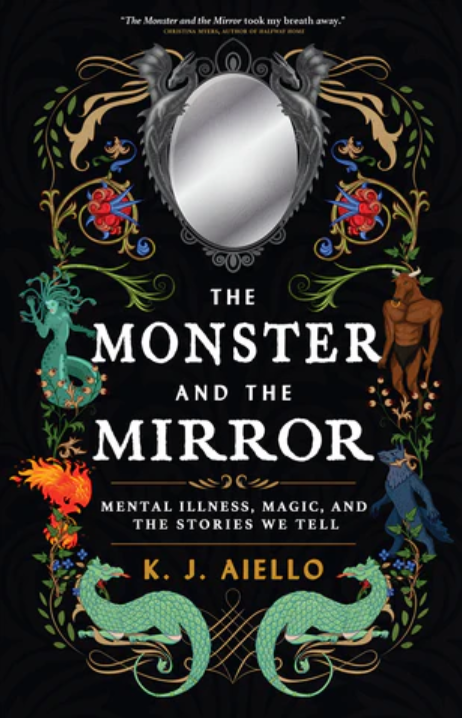
Toronto-based author K.J. Aiello brings The Monster and the Mirror to the public, unabashedly announcing K.J.’s status as an award-winning and mentally ill writer who wishes to share a history of mental disturbance, depression, and the ultimate recognition of an inability to hold regular jobs. Of the over 800 books I’ve read in the last decade, I regard The Monster and the Mirror as one of the most important.
An extremely well-crafted record of a troubled life, the success of the volume is clearly attained through K.J.’s varied authorial skills; from the very first pages, these skills quickly surmount the limits that might have appeared when first setting down this story. K.J. offers oft-painful personal testimony using several pragmatic literary techniques. Among them is the descriptive use of other authors’ works that serve as hinges to ongoing struggle—The Hobbit, meaningful interpretations of the Marvel Comic Series, excerpts from X-Men movies, and Gothic horror passages from Shirley Jackson’s The Haunting of Hill House, among others.
K.J. also acknowledges how difficult it is for those who are mentally unwell to find ways to portray their mental disturbances. (Children, for example, do not yet have even the basic vocabulary to begin to describe their agonies.)
K.J.’s success is strengthened by wide and varied literary associations and by a persistent commitment to communicating this story. Personal reflections (direct memoir passages) are set off in a dedicated print font. The recurring terminology of “monster” and “shadow” is put to especially good use—terminology that remains devoid of repressive reproaches and fruitless fantasy. Honesty sits at the top rung of these literary endeavors.
Because the topic is so painful, all these literary devices acquire unusual urgency—for the reader yearns for small comforts or elements of resolution throughout the volume. True to Lisa Cron’s method of writing toward the “Wired” needs of the reader, any sense of relief can begin to emerge only in the penultimate and final chapters.
Demons repeatedly attempt to bring K.J. down. Repeatedly, K.J. rises up, ultimately facing such profound questions as what is a good death? and, perhaps more significantly, what is a good life? These questions are important to both the healthy and the unhealthy—and vital to those who feel unseen and unheard.
On page 8, K.J. refers to Mary Shelley’s Frankenstein as one who “grieves for himself in his loneliness…for the certain impossibility of leading a normal life.” K.J. adds, “I feel this a lot. This same grief will probably sit with me for the rest of my life.”
As a child, K.J. is unable to understand the mountainous, uncontrolled anger experienced on a daily basis. K.J.’s parents repeatedly affirm how special this child is. K.J.’s mother says, “Be careful. The world is a cruel place. There is no one to protect you but me.” K.J.’s father challenges the child to be his special helper. But soon come the admonitions: “Get control of yourself, because these outbursts are too hard on your mother.” K.J. tries but cannot squelch the internal voices that intrude. Anger breaks through in repeated volcanic eruptions. When financial disaster and the mother’s ill health visit the family, K.J. faces renewed powerlessness.
On page 21, K.J. writes:
“There is another kid in my new class who likes to call me names. One day she tells me I should kill myself. She ends up with the sharp end of my pencil embedded in her arm. My Shadow and I laugh, and I am sent to the principal’s office again. Another silent ride home, and my mother slides into worry. She is trying to balance her unbalanced daughter and the creature that is coming in the night to take her own life. She doesn’t have the tools to manage me or the Shadow growing deep in my bones.”
What follows in K.J.’s tumultuous life are periods of horrendous amounts of alcohol use, rage, striving and failure, suicidal attempts, and repeated confinements in “mental health” institutions.
The final chapters bring insightful realizations about the failings in Canada’s treatment systems for the mentally ill and about K.J.’s own mismanaged care in particular. The memoir implicitly calls for needed changes—kinder housing laws and approaches that better support those attempting regular employment under nearly indescribable adversities. K.J.’s voice in The Monster and the Mirror stands as a substitutionary voice for others who have not yet attained, or cannot achieve, agency over their own sufferings.
The Monster and the Mirror: Mental Illness, Magic, and the Stories We Tell
K.J. Aiello
ECW Press
Did you like this Book Review by K.J. Aiello? Then you might also like:
Smallwood Offers Style and Intriguing Content
Shapes of Native Nonfiction
Layered Poetry in heft by Doyali Islam
Sam sax’s Madness Under Examination
Take a Does of Michael Pollan’s Latest Batch, How to Change Your Mind
Through, Not Around: Stories of Infertility and Pregnancy Loss