Fledgling
– Fiction by Ruth Kennedy –
Sprung early from school in mid-May, Rose Wilson started her ‘wild rose summer,’ by boarding a VIA Rail train in Kingston, Ontario. This was the summer she turned 12, so this four-month adventure to Alberta included her parents and her three younger siblings.
After two days landlocked in the northern Ontario woodlands, it was a startling change to arrive on the prairies. Rose watched attentively as the grassy ocean whizzed by on its horizontal plane under an enormous sky. The train picked up considerable speed on the flat land so the now familiar motion of the car rocking on the rails, and the sound of metal sheering against metal had become rhythmically more complex.
It took three days to arrive in Edmonton. From there, they were transported out to a house on the prairie, south of Vegreville. The first thing Rose noticed from the window of the car during the ride from Edmonton is that wild roses were everywhere.
It was 1977 and Rose’s father had just finished his first year of studies in theology. This family venture was to fulfill his first assignment as a student minister. Rose had been a little mystified by her father’s decision to quit a good paying job to go back to school. He had explained to them, briefly, that he had had a calling that could not be ignored. His calling required the whole family to follow.
The house they moved into that summer was painted white and surrounded by coniferous trees and tall bushes. On the lot next door was a little white church. Beyond the church and the house were open fields, endless sky, and no other humans beings or buildings in sight.
Rose was enamoured of everything that was new, soaking it in like a sponge. She adored the sunny warm days of late May, but was especially partial to the evenings when the air cooled down and the dusk stretched out longer than she had ever experienced. She liked to stay outside as late as she could, watching the sun set and the evening settle.
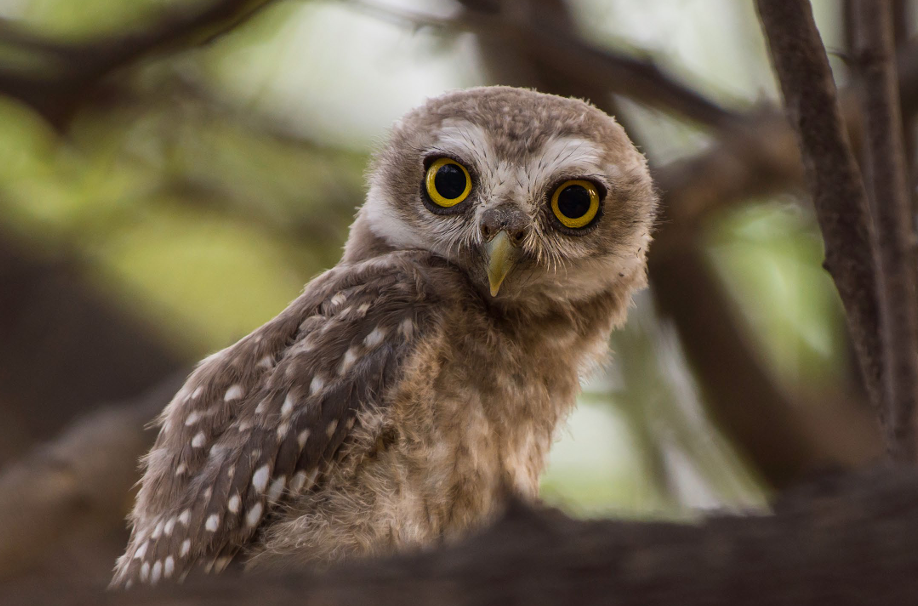
Puttering outside one evening, she heard a different kind of noise in the long grass by the hedge near the house. It was not the sound of a kitten but of some other small creature. She waded carefully through the tall grass until she found, nestled down close to the earth, a perfectly round ball of light grey fluff. It had two black eyes and a tiny orange beak. Rose was delighted. She had never seen anything quite this cute before.
“Hi,” she managed to half speak, half whisper, “who are you?”
They stared at each other for awhile, then suddenly, the little ball of grey fluff squeaked out a sound and stood up.
Beneath it appeared two spindly orange legs, the same colour as the beak.
There came a distinctively adult squawk from high up in the treeline at the edge of the property. The fluff ball turned
suddenly away from Rose and started to navigate through the tall grass towards the trees, using small wings not seen until now, to push past the grass.
Rose called to her siblings and waved them over, excited to share this finding with them, but then she had to hold them back as in their enthusiasm they wanted to touch, even to pick up, this little creature.
“Don’t touch it! The parents might abandon it!” Rose was recalling her own parents’ admonition when she had found
a robin’s nest back home. “Don’t touch the eggs or the nest, you might scare away the mother.”
Her siblings, dissatisfied with just standing around, soon tired of it and headed indoors for the evening. Rose settled
in alone to witness the long journey ahead. She didn’t mind. She was accustomed to spending time on her own.
Squeak?
Squawk!
Clearly, these two creatures belonged together, but what kind of bird was up in the tree? Rose dashed into the house to grab her father’s binoculars. Back outside, she focused on the direction of the squawk and could see the distinctive outline of an owl, but what kind of owl, Rose did not know. The owl was perched on a tree branch high up in the eighth tree of the row.
So, this creature on the ground was a baby owl, an owlet. Still painstakingly working its way through the grass to the treeline, the owlet continued to squeak to get a squawk. It took an hour for the little one to reach the row of trees with Rose watching patiently. Then it started to climb the first tree.
Squeak?
Squawk!
It floundered its way up the trunk one branch at a time. About ten feet off the ground, the owlet realized this was not
the right tree, so it came awkwardly back down the trunk, shuffled over to the next tree in line, and started to climb
again. Rose watched, fascinated by the determination with which the owlet struggled up the second tree trunk. And back down again.
Rose counted the trees to the one where the parent presided. If the owlet intended to climb each tree to get to
the parent’s tree, there were six more trees to go. There was no way to communicate to the owlet to jump ahead a few trees. And why did the parent owl not come down to rescue the owlet? Rose remained far back to make sure she wasn’t the cause of this.
It didn’t occur to her that an owlet would leave the nest even before it could fly. That strengthening its legs was important for its development. That the parent had not abandoned the owlet, but rather, was calling it home. And the owlet’s job was to find its way there. That only the owlet could insist on living.
Squeak?
Squawk!
The dusk crept further into grey, but Rose was undeterred, her eyes adapting to the low light. She heard her mother call out, “Rose, it’s too dark to be out, you need to come in now.”
“I can’t,” Rose called back, “not yet, the owlet isn’t safe yet.”
“Then come and get your jacket.”
It was cooling down, and now that she wasn’t moving around, Rose was starting to feel the chill in the spring air.
Her jacket was welcome.
Rose felt compelled to witness the reunion. She was in fact a little terrified that she might not. That the owlet could fail from exhaustion or succumb to the coyotes as prey. Or just give up. The call and response continued, with the squawk growing louder the closer the owlet got.
Squeak?
Squawk!
In this way, the owlet’s journey continued through another long hour. It did not skip ahead. Rose remained anxiously
present, focused on the owlet as it climbed each tree and scrabbled back down to ground. Still two trees away from
the parent.
Squeak?
Squawk!
When there was barely enough light left to make out the outline of the tall trees, the owlet at last reached the tree
where the parent waited for it at the top. The owl climbed all the way up this time until it reached the top. The reunion was a silent one. Rose never saw the owl or owlet again, but she slept well that night knowing she had seen the owlet to
safety.
The following Sunday morning Rose sat in the little church. She half-listened to her father’s sermon, mesmerized by
the dance of suspended dust caught in a sunbeam. She heard his words but had no idea what he was talking about. Sometimes she pretended she understood hoping this would close the growing gap between them. Whether he was standing in the pulpit or sitting in his study, immersed in books and thoughts and words, he seemed as remote and abstract to her as God.
When a mouse ran across the sanctuary the following Sunday morning, squeezed out of the old pump organ during the opening hymn, Rose was delighted and horrified in equal measure. The old organist didn’t notice, her father didn’t notice, but everyone else did, and a tittering kind of commotion erupted. If this was truly God’s world, Rose was glad it included the owlet and the mouse, and such serendipitous humour.

About the Author – Ruth Kennedy
Ruth Kennedy is an emerging writer based in Ottawa, Ontario. Ruth writes poetry and stories to capture life’s rich mysteries and to touch the lives of others. She is a member of Haiku Canada and Ottawa Independent Writers and has been published in anthologies for both organizations, as well as in Bywords and the Globe and Mail.
Keep Reading…
- -ed
 “You don’t realize the extent that you loved until it’s gone but I’m removing the -ed because I still love you.”
 - ‘I Have Been a Stranger in a Strange Land’ Exodus 2:22
 The boat stares back with many eyes. Some closed in prayer, others close to fainting. A few people imagine childhood homes or hold photos of a small Italian port. Some cry. Some are confused.
 - “Early Blossoms” and “Ontario Thaw”
 Alone on a mesa, a pink crabapple tree embraces the wind, its branches reaching up and out like a menorah, its petite blossoms a pointillist image…
Meanwhile, at Dreamers…
Last chance! Stories of Place, Home, and the Meaning of Dreaming
The deadline for the Dreamers Writing Contest on place and home is January 31. Submit a heartfelt story, poem, or essay reflecting on belonging, memory, displacement, or the meaning of home. Open internationally. $250 CAD prize and publication.
Editor’s Note: Issues 21 and 22

We’re pleased to announce the simultaneous release of Dreamers Magazine Issues 21 and 22.These two issues were shaped during very different moments…